By Norman R.
Lead-based paint was banned for residential use in the United States in 1978 by the Consumer Product Safety Commission, after research showed that dust from flaking lead paint causes serious neurological harm, especially to young children and pregnant women. If your home was built before 1978, there is a good chance legacy lead paint is still there, buried under newer layers on trim, doors, windows, plaster, and siding.
Quick Reference: Lead Paint Regulations
Do not sand, scrape, wire-brush, or dry-heat old paint in a pre-1978 home without testing first, or without treating it as active lead paint. Power sanding and dry scraping turn solid paint into microscopic dust that spreads through living areas, settles on floors, and gets into ductwork.
- Federal residential ban: 1978, by the CPSC.
- Primary hazard: inhaling or ingesting lead dust from sanding, scraping, or friction on sashes and doors.
- EPA RRP rule: disturbing more than 6 sq ft of interior or 20 sq ft of exterior paint in a pre-1978 home requires an EPA Lead-Safe Certified contractor.
- Safe plan: test with an EPA-recognized swab kit, or assume lead is present and use wet-sanding with 6-mil plastic containment.
Before 1978, manufacturers added lead carbonate and lead chromate to oil coatings for faster drying, durability, and moisture resistance. Probability tracks with age: HUD data shows about 87% of homes built before 1940 contain lead-based paint, versus 24% of homes built between 1960 and 1977.
Climate changes how it degrades. Humid coastal air delaminates old oil-based lead primers off wood. Northern freeze-thaw cycles stress double-hung sashes, creating dust every time one slides. High-UV Western sun breaks down exterior binders until the lead paint underneath chalks into the soil.
The History of Lead Paint Regulation
Lead paint was standard in American construction through the 19th and early 20th centuries because of its opacity and water resistance. Health data forced it out in stages.
The 1971 Lead Poisoning Prevention Act
Concerns surfaced in the early 1900s and led to the Lead-Based Paint Poisoning Prevention Act of 1971, which limited lead content in paint used in federally funded housing and set the baseline for later consumer standards.
The 1978 CPSC Nationwide Ban
In 1978 the Consumer Product Safety Commission banned the manufacture and sale of lead-based paint for consumer residential use, capping lead content at 0.06% (600 ppm) by dry weight. The Consumer Product Safety Improvement Act lowered that to 0.009% (90 ppm) in 2009.
The 2010 EPA RRP Rule
The ban stopped new sales but left millions of older homes with existing lead layers. To protect occupants during renovation, the EPA enacted the Renovation, Repair, and Painting Rule in 2010, requiring contractors working on pre-1978 housing to hold certification and follow lead-safe containment. Assessing existing coatings before recoating matters here too, which we cover in our guide on whether you can use old paint.
How Do You Test a Pre-1978 Home for Lead Paint?
Do not assume a wall is lead-free because the top coat looks smooth. Lead paint routinely sits under six or seven layers of modern acrylic.
Chemical Spot Test Kits
EPA-recognized swab kits use a reagent that changes color on contact with lead ions. For an accurate reading you have to cut through every coating layer down to bare substrate before swabbing. Testing the top layer alone misses lead buried deep in the stack.
Portable XRF Inspections
Certified inspectors use X-Ray Fluorescence analyzers, which read lead concentrations through multiple layers down to bare wood or plaster without damaging the surface, reported in milligrams per square centimeter. Detailed prep over historic trim is a core part of our interior painting work.
“Pro tip: never swab the surface coat when testing pre-1978 trim or lap siding. Legacy lead sits at the bottom of the stack. Score a 45-degree V-notch through every layer down to raw wood and apply the swab into the cut cross-section so the reagent reaches the lower coats.”
Where Lead Paint Is Most Dangerous
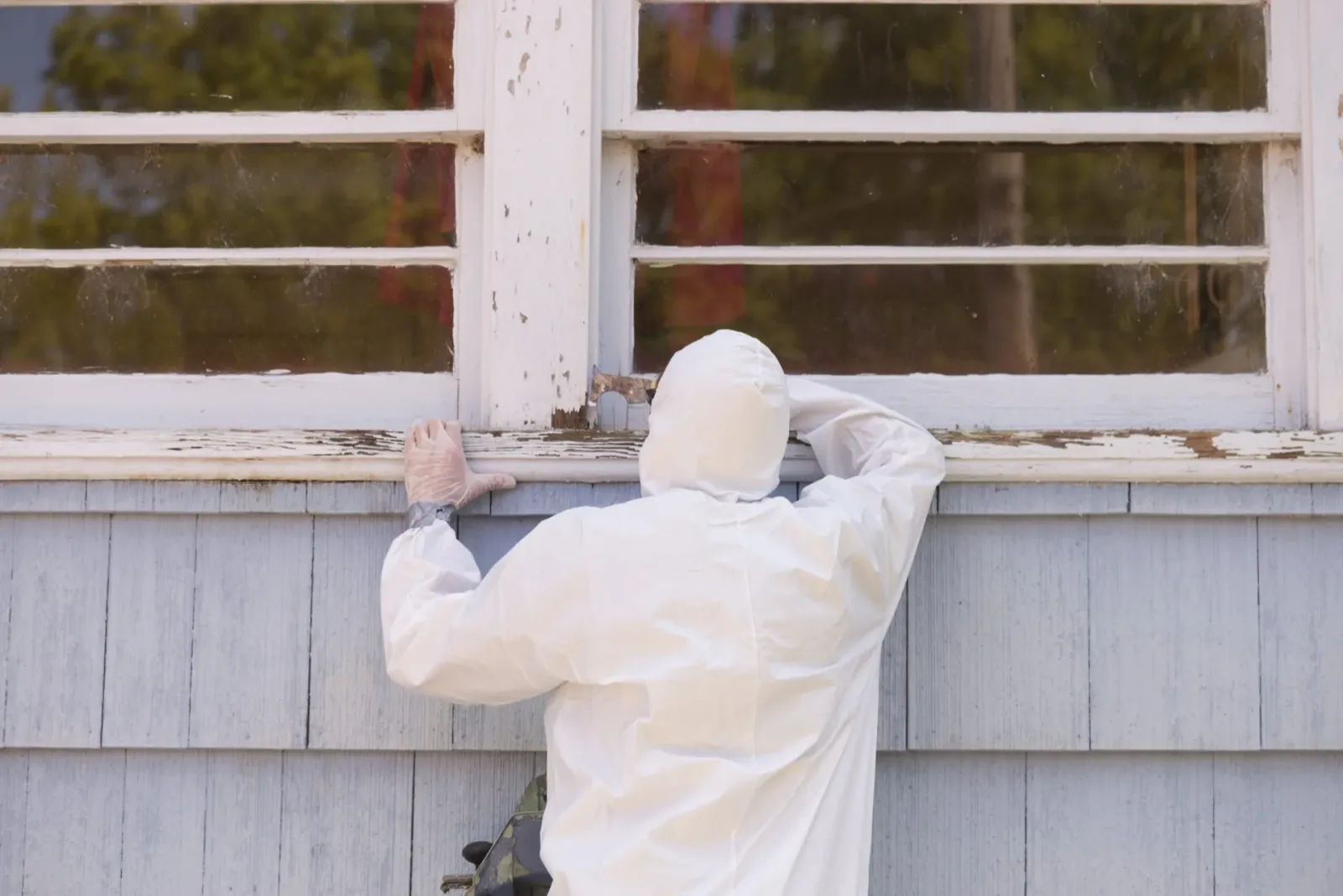
Intact lead paint under intact topcoats is low risk. The danger comes from deterioration and friction.
Friction and Impact Surfaces
Double-hung windows, doors, jambs, and stair handrails are the high-risk zones. Every time a wooden sash slides it grinds the lead coats underneath into fine dust that collects on sills and floors, and door edges rubbing jambs do the same. Careful prep on trim and doors comes first, which we cover in our guide on painting cabinets with doors.
Cracking and Peeling Paint
Moisture and settling break adhesion over time, and peeling, cracking, or alligatoring paint releases chips and airborne dust into living space. Children who ingest flakes or breathe settled dust face real harm. When planning historic interior work, see our guide on color drenching.
“Pro tip: when removing loose lead paint from pre-1978 siding, skip dry power sanding and high-pressure dry scraping, which spread dust across neighboring yards. Mist the surface with water to suppress dust, then hand-scrape with carbide scrapers or use a shrouded disc shaver on a HEPA vacuum rated to capture 99.97% of particles down to 0.3 microns.”
How Lead Paint Is Handled Safely During a Repaint
Managing lead paint means following EPA Lead-Safe Certified procedures to capture and contain every bit of debris.
Containment Zones
Before anything is disturbed, the work area gets isolated with heavy 6-mil plastic sheeting, doorways get plastic dust locks, and HVAC supply vents are sealed so dust cannot circulate. Outside, 6-mil ground covers extend at least 10 feet from the foundation to catch falling scrapings.
Wet Prep and HEPA Cleanup
Un-shrouded power tools, open-flame heating, and dry hand sanding are prohibited under RRP rules. Crews use wet sanding sponges, misted scrapers, and approved strippers, then run a three-stage cleanup: HEPA vacuum, wet scrub with detergent, HEPA vacuum again.
The same containment thinking applies to exterior masonry, covered in our guide on cleaning limewashed brick, and protective exterior coatings are part of our exterior painting services.
Lead Risk by Housing Era
Use construction era to gauge probability, risk locations, and what containment the job will require:
- Pre-1940: high probability (~87%). Exterior siding, double-hung windows, plaster, trim. Full shroud containment and HEPA prep. RRP compliance mandatory.
- 1940-1959: moderate-high (~69%). Window sashes, door jambs, baseboards, porch rails. Plastic floor covering and wet-sanding. RRP compliance mandatory.
- 1960-1977: moderate (~24%). Door casings, kitchen cabinets, exterior trim. Spot testing and plastic drop containment. RRP compliance required if lead is detected.
- 1978 and later: essentially none. Standard drop cloths and dust control. Exempt from federal lead-safe rules.
“Pro tip: encapsulating intact lead paint is not a job for standard interior latex. Use elastomeric or epoxy-modified encapsulants tested to ASTM E1795, applied with a 1/2 to 3/4-inch nap roller or airless sprayer to a dry film thickness of 7 to 10 mils, roughly three times a normal wall coat. That builds a durable shell that seals lead dust behind it.”
Common Lead Paint Questions
How do I know if my home has lead paint under latex layers?
Testing is the only way. Use an EPA-recognized swab kit with a V-notch cut through every layer to bare substrate, or hire a certified inspector to run a non-destructive XRF test.
Can you paint over lead paint to make it safe?
Yes, if the lead paint is tightly bonded and not flaking. That method is called encapsulation, and it uses a specialized elastomeric encapsulant rather than ordinary topcoat to seal the lead behind a thick barrier.
Is it legal for a homeowner to remove lead paint themselves?
In most jurisdictions, EPA RRP rules apply to paid contractors rather than homeowners working on their own primary residence. Even so, follow the same practices: wet sanding, a P100 respirator, 6-mil plastic containment, and HEPA cleanup.
What is the difference between lead abatement and lead-safe repainting?
Abatement permanently eliminates the hazard through component removal or permanent enclosure, and is done by state-certified abatement contractors. Lead-safe repainting under the RRP rule focuses on safely preparing and painting surfaces so the hazard stays contained during normal maintenance. They are different certifications.
What should I do if lead paint is flaking off my siding?
Do not dry-sand or pressure-wash it. Lay 6-mil plastic along the ground to catch debris, mist the siding to suppress dust, hand-scrape loose flakes with a carbide scraper, collect every chip for proper disposal, then prime and recoat.
Updating a Pre-1978 Home Safely
Prepping and repainting a home with legacy lead paint takes training, certified containment gear, and strict RRP work practices. It is the clearest case in residential painting where the prep matters more than the paint.
That 1 Painter offers lead-safe renovation in select markets whose teams hold EPA Lead-Safe certification. Check your local market on our locations page to see whether it is available near you.
Contact That 1 Painter to schedule a detailed, obligation-free on-site estimate. Every home is different, so final pricing always comes from an in-person assessment of materials, prep, and surface condition.
